© Copyright 2026, Crossroads Mission Works. All rights reserved.
Who We Are
This is our church. We are a mission-oriented body of believers committed to biblical life, sacramental fellowship, and the service of others, free from the modern denominational dogma which continues to drift from the Word.
What We Do
We were sent to serve.At Crossroads Mission Works, we gather around the Word and the Table, and from there we are sent. Because Christ first served us, we serve our neighbors through hard work, friendship, and care for the people of our community.We also go into the wilderness, as God's people have before us, to step away from the noise of modern life, to learn our dependence on Him and on one another, and to enjoy the world He made.For us, the wilderness is not an escape. It is a training ground. What we learn on the trail, we put to work in town. Every trail we clear, every meal we serve, and every neighbor we help is the fruit of grace we have already received, and a witness to the Lord who gave it.
1:1
We believe a life of service and wilderness challenge is best lived with a clear conscience and a steady spirit.If you are struggling to find your footing, or if the burdens of life have become too heavy to carry alone, we offer one-on-one counseling with our Chaplain, an ordained Minister.We walk with you as brothers and sisters in the faith to talk through your challenges, look at them through the lens of the Word, and seek the wisdom of Christ together.This is not about hollow advice or clinical checklists. It is about honest, direct conversation aimed at restoring your walk with the Lord so you can get back to the work He has for you.We're here for anyone in our community, without qualification or cost. Contact us now.
Missions
So also faith, if it does not have works, is dead being by itself. ~ James 2:17
Crossroads Mission Works is founded on the uncompromising truth of James 2:17—that faith devoid of tangible, physical labor is not merely incomplete, but dead. We believe the gospel is meant to be lived out with calloused hands and a visible presence in the community, rather than confined to passive belief or abstract sentiment. Our developmental missions are the heartbeat of this conviction, as they move our staff from the sterility of office-based management into the direct, high-friction reality of human need and structural restoration. By engaging in this essential labor, we ensure that our ministry remains a living, breathing force for the Kingdom, sharpening our skills and strengthening our commitment to the land and people we serve in a way that mere theory could never achieve.
Next Up:
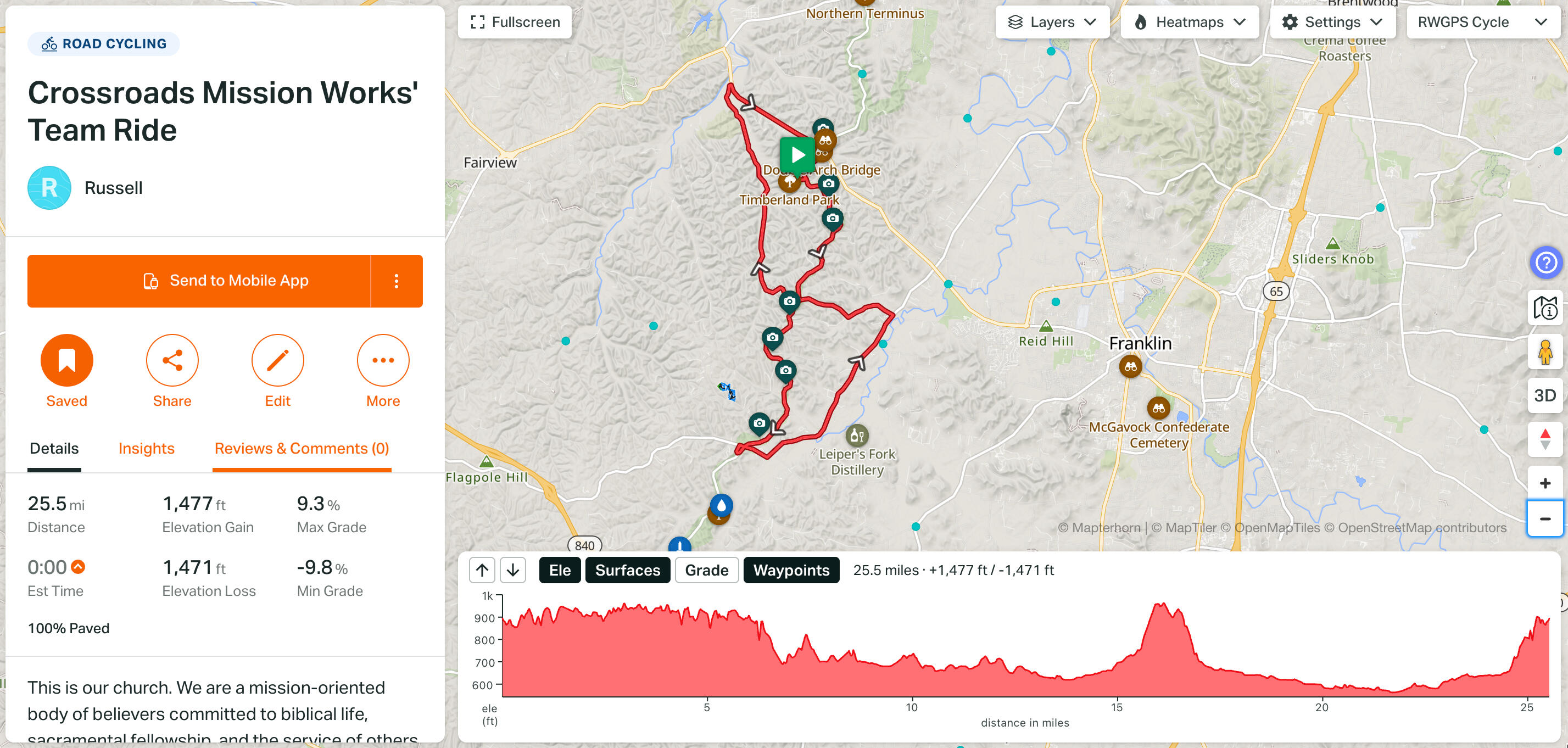
✟ We love to ride. We have a standard Team Ride which offers a good, safe pace for everyone. We leave no rider behind, and we take a long, leisurely break in Leipers Fork for lunch and fellowship. Contact us for departure times and dates.
✟ Join us as we provide coffee to a number of missions in the Nashville area. We are grateful to our friends at Triana Coffee for generously donating to our cause. Contact us to help.
Contact Us
You have questions? We have answers!Drop us a line. We're here to help.
Frequently Asked Questions
Is this a church or a mission?
It's both. The theological training is second to none. High quality biblical education and missional theology need to be available to a wider audience. The bible is very clear that the "church" in the bible is about a people, not a building. (1 Corinthians 3:9, Ephesians 2:19-22, Acts 7:48-49, Matthew 18:20, 1 Peter 2:5, Colossians 1:18, Romans 16:5, Revelation 21:3). This church is a mission run by dedicated missionary theologians who understand the existential threat to Christianity in the face global demographics, declining western birth rates, and the deleterious influence of technology. Our tent must be bigger. We must invigorate those most likely to dwell in Christianity.Is there a brick and mortar building where you worship?
We don’t view the Church as a place you visit, but as the living body of believers we embody wherever we gather. Following the example of the early Church, we meet in homes, businesses, third-spaces, and the outdoors to keep our faith integrated into the daily rhythms of life rather than confined to a Sunday morning event. By focusing our resources on discipleship and service rather than building maintenance, we remain agile, mission-focused, and deeply committed to the people and the land we serve, trusting that Christ is present wherever two or three are gathered in His name.Is there a Minister and is he ordained?
Yes. He holds multiple non-theological degrees in his lifelong professional discipline. Additionally, his seminary training is from the Reformed Episcopal Seminary in Orland, Pennsylvania. He is member in good standing of the National Association of Christian Ministers, and a licensed Chaplain. He is a lifelong missionary and adventurer.What denomination do you practice?
None. We are non-denominational. The Holy Bible is non-denominational. We follow it, not a franchise.What, then, do you believe?
We believe in the divinely inspired authenticity of the Holy Bible and in the ancient principle of sola scriptura— scripture alone as the final authority. We seek to understand the full message within it and to make that understanding available to anyone willing to learn.What bible do you use?
The NET Bible — a ground-up translation from the best available Hebrew, Aramaic, and Greek texts, developed by more than one hundred scholars. We find it best suited for clear communication across cultures, languages, and life circumstances. It's also a fantastic learning bible, with academic cross references to further enhance your biblical education when you're ready.Do you use a Prayer Book?
We use the 1662 Book of Common Prayer. Although non-denominational, our roots are in the Reformation and The Reformed Episcopal Church due to their adherence to sola scriptura. The 1662 Book of Common Prayer is a great resource for any Christian.Who do you serve?
God above. Here, anyone. Inmates. Addicts. The grieving. Workers in remote or dangerous environments. People who have been turned away by traditional churches. People who have never set foot in one. There is no qualifying condition. If you need a chaplain, you have one.Where do you serve?
Our Chaplain serves the Nashville, Tennessee metropolitan area in person, and can serve anyone, anywhere by phone. Additionally, we often travel on missions and adventures.I'm in a highly regulated career field where I could be subject to unwanted scrutiny if I receive counseling. Can you help?
Yes. Any counseling is covered by Clergy-Penitent Privilege, subject only to disclosure for child endangerment or imminent harm.My group is going on an adventure. Will you travel with us and provide spiritual advice and counseling along the way?
Absolutely. It's a wonderful experience for everyone. Our Chaplains are men of the world. They are fit, talented adventurers themselves after traveling the world for years--decades in some cases. They live life to the fullest, in ways you will never see your traditional spiritual leader enjoying. You do you. You're not going to surprise or offend our Chaplain.Will you come to a prison or jail?
Yes. If access can be arranged, we will be there.Will you work with someone in active addiction or long-term recovery?
Yes. Without hesitation, without precondition, and for as long as the journey requires.Do I have to be a Christian?
No. We are Christians. You don't have to be. We take all comers. The door is open to anyone who walks through it — or anyone who needs us to walk through theirs.What does the chaplain actually do?
Whatever is needed. Spiritual counseling. Crisis intervention. Long-term companionship through grief, recovery, or incarceration. Marriage counseling. Officiating weddings — in a barn, on a trail, in a parking lot. Visiting the sick and the dying. Listening, when no one else will. He is not here to preach at you. He is here to be present with you.Why is denominational church attendance rapidly declining in the United States?
Research shows there are several reasons for the rapid decline, all of which serve as an indictment of "traditional" denominational churches. When considering church, seminary, or other religious education, purveyors of the failing model might not be the best choice for success. The largest contributing factors are:
✟ Churches following "trends" and endorsing heretical lifestyles.
✟ Church scandals.
✟ Lack of service options.
✟ Technology.
✟ Social Media.
✟ Glorification of materialism and consumerism.What do people wear when working with the church?
Come as you are--jeans, cowboy hat, work gloves in your back pocket. If we're hiking or riding bicycles, dress in appropriate gear. Dress for the weather, for safety, and for comfort. We're not here to impress each other, and we are far from prudish. In the austere outdoor environments where our adventures lead, modesty is a rare luxury. We just ask that you "read the room." We don't judge, nor are we easily offended.I'm in need of spiritual counseling. Is someone available?
Always. Our Chaplain will make himself available as needed for general spiritual counseling. Further, he and the church have a deep well of knowledge and can refer you to the community should you need more specialized counseling.I'm in need of marriage counseling. Is someone available?
Yes. We offer general spiritual counseling, to include spiritual marriage counseling.I'm getting married. Can someone from the church marry us?
Yes, of course. We'd be honored. Please contact us to get started.We want to get married in a non-traditional setting. Will the Officiant mind being outside, in a barn, or in a pavilion?
We'd love it. We're missionaries. You can't get far enough off the beaten path for us. We would be honored to do so. Please contact us to get started.Someone I care for is not well. Can someone come to my loved one for spiritual care?
If it all possible, we will. Please contact us to get started.Are donations to the church tax deductible?
Our church is well funded. We don't accept individual donations, but we do ask that you support the businesses who support us, namely Triana Coffee Company and Crossroads Cycle Works.Is there a cost involved with asking for a Chaplain?
Never. Our benefactors pay for everything.Why is this needed?
Because the traditional church is failing the people who need it most. Denominational attendance is collapsing — and for reasons that amount to an indictment: scandal, complacency, trend-chasing, and a preference for comfort over mission. Meanwhile, people are more isolated, more addicted, more desperate, and more spiritually starved than at any point in modern memory. They are not going to come to a building. Someone has to go to them. That is what a mission is. That is what we do.
Sola Scriptura
The Bible presents salvation as a divine plan unfolding through historical revelation, centered on the person and work of Jesus Christ. This understanding begins in Genesis with humanity's separation from God through sin, followed by God's promise of redemption. Through the Old Testament, we see this promise developed through covenants with Abraham, Moses, and David, each adding depth to our understanding of God's salvific purpose.The New Testament then reveals how these promises find their fulfillment in Jesus Christ. The Gospels present Jesus as both the promised Messiah and the divine Son of God who takes away the sins of the world. The epistles, particularly Paul's letters, explain how Christ's death and resurrection accomplish salvation through faith.When we examine the biblical text closely, we find salvation described as both a divine gift and a human response. The Greek word σωτηρία (soteria) encompasses deliverance, preservation, and spiritual wholeness. Essential elements include:Understanding Our Need: Scripture reveals humanity's fundamental problem - separation from God through sin (Romans 3:23). This diagnosis helps us recognize our need for divine intervention.God's Initiative: The Bible emphasizes that salvation originates with God's grace rather than human effort. Ephesians 2:8-9 states this explicitly: "For by grace you have been saved through faith, and this is not your own doing; it is the gift of God."The Role of Faith: Scripture presents faith as the means by which we receive salvation. This faith involves both intellectual assent to truth claims about Jesus and personal trust in Him as Savior. The Gospel of John particularly emphasizes believing (πιστεύω) as the key response to Jesus.The Work of Christ: The Bible explains how Jesus' death serves as an atoning sacrifice for sin (Romans 3:25), while His resurrection ensures new life for believers (Romans 6:4). This forms the historical and theological core of salvation.The Spirit's Role: Scripture teaches that the Holy Spirit enables understanding of divine truth (1 Corinthians 2:12-14) and brings about spiritual transformation (2 Corinthians 3:18).
What is a church?
The term "church" in the New Testament derives from the Greek word "ekklesia" (ἐκκλησία), which carried significant pre-Christian connotations that shaped early Christian understanding. In classical Greek usage, ekklesia referred to an assembly of citizens called out from their homes into a public place for civic purposes—essentially the democratic assembly in Greek city-states. When early Christians adopted this term, they infused it with new theological meaning while retaining its essential character as a "called-out assembly." This linguistic choice was deliberate and profound; rather than selecting terms associated with religious buildings (like "hieron" for temple), the apostolic writers emphasized the church as a community of people summoned by divine call into a new covenant relationship. The ekklesia was thus understood not as a physical structure but as a living organism—what Paul would later describe metaphorically as the "body of Christ."This understanding of church as community rather than location manifested in the earliest Christian gatherings, which occurred primarily in domestic settings. The New Testament presents multiple models of ekklesia: the household church (oikos), the city-wide church (comprising multiple house churches in urban centers like Corinth or Ephesus), and the universal church (the entire community of believers across time and space). Each expression maintained the fundamental characteristic of being a people set apart through divine summons. Early church fathers amplified this understanding, with Ignatius of Antioch famously declaring that "wherever Jesus Christ is, there is the catholic [universal] church." This ecclesiology stands in stark contrast to later institutional developments where "church" became increasingly associated with hierarchical structures and sacred buildings rather than the apostolic emphasis on the gathered community of believers.